
Memory modules can be defined as memory chips on a small circuit board. The memory chip includes dynamic random access memory integrated circuits.
Originally, memory chips built into the system by single or dual inline package (DIP) chips. It was tedious and time consuming to deal with DIP-chips. Since the system experienced thermal changes on heating and cooling, crawled up the chips from their sockets, to a "chip creep" phenomena. This resulted in memoryErrors. Closing pressure, the chips back into the base solved the problem, of course, but it was labor-intensive when a number had to be supported by systems.
"Laptp Memory"
A better alternative for the prevention of "chip creep" was to the memory on the motherboard / Expansion Card Lot. With these compounds were stable, but there was another problem. When the chip was bad, it had to be de-soldered and a new one had to re-soldered or even it was necessary to scrap the motherboard / memory card, where theChip was installed. This proved to be very expensive and memory debugging is a difficult task. A chip that both soldered and removable was required, and to a memory module or SIMM Single Inline Memory Modules called. used in desktop systems most often are two main types of Simms, three types of DIMMs, and a type of RIMM. On the motherboard or the memory card of the special connectors to get these little boards connected. They are indeed soldered into the module andRemoving / replacing is almost impossible. If a part fails, the entire module has to be replaced.
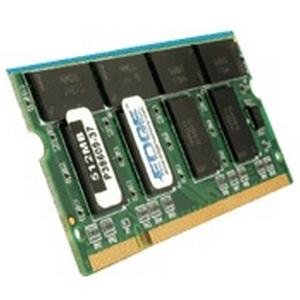

- 512 MB
- Lifetime Warranty
SIMMs are in 30-pin or 72 pin physical types. The 30 pin has 8 bits and an option for 1 additional parity bits. The 72 pin has 32 bits plus an option for 4 additional parity bits. Both versions can chip on one side or both sides, except that 30 pin SIMMs are actually physically smaller than the 72-pin version.
DIMMs (Dual Inline Memory Modules) are in three mainVersions of standard DIMMs with 168 pins with a notch on each side and two notches on the contact area. DDR DIMMs with 184 pins and two notches on both sides and an offset notch along the contact area. DDR2-DIMMs with 240 pins with two notches on both sides and a notch in the middle of the footprint. The DIMMs are dual in-line because they have different signal pins on each side of the module. They have a lot more pins than a SIMM with only 1 "of additional length.
RIMM(Rambus In line Memory Module) have different signal pins on each side. They come in three physical types-a 16/18 bit version with 184 pins, a 32/36 bit version with 232 pins and 64/72 bit version with 326 pins. All these cables in the same size plug, but vary notches in the connectors. In the standard 16/18 bit RIMM, there is a notch on each side and two notched centrally in contact area.
Memory modules of three different Red vs. Blue Reconstruction 19; Finale Video Clips. Duration : 9.73 Mins.Buy the DVD: roosterteeth.com The final chapter of Red vs Blue Reconstruction. Originally aired Summer 2008.
Keywords: Red, vs., Blue, Reconstruction, chapter, 19, rvb, vs, Rooster, teeth, halo, machinima, funny, comedy, wash, caboose, meta


 Posts
Posts


No Response to "Memory modules of three different"
Post a Comment